TensorFlow Demos
Bidirectional LSTM
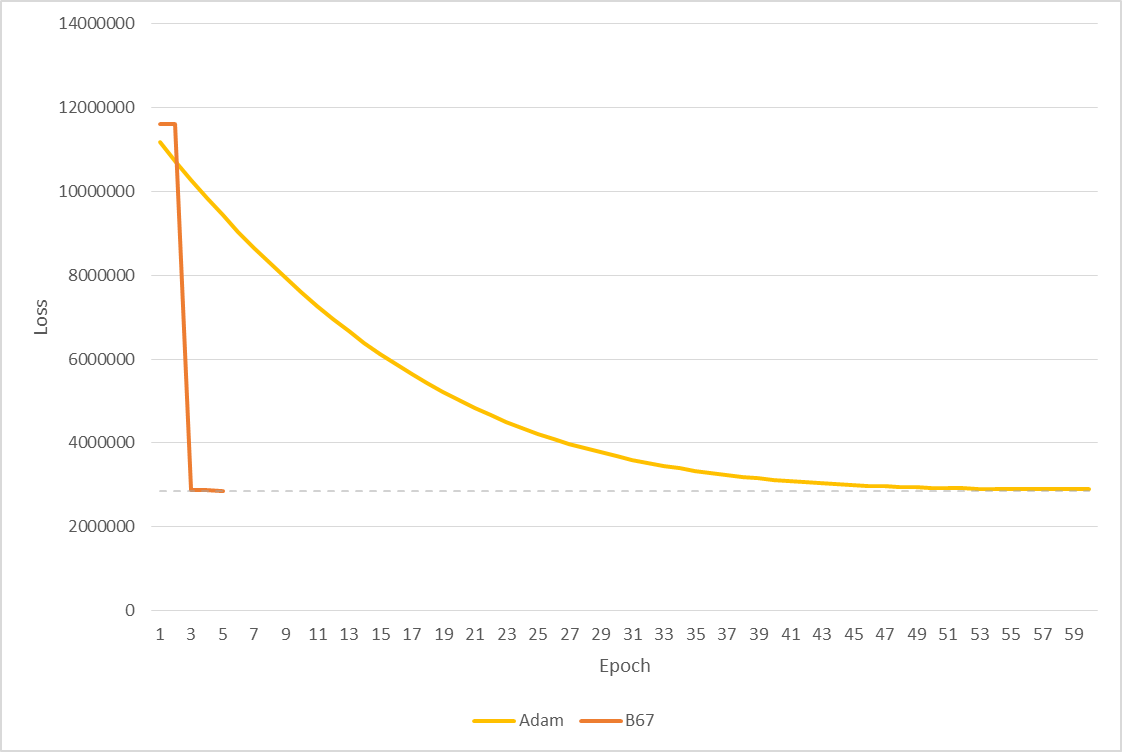
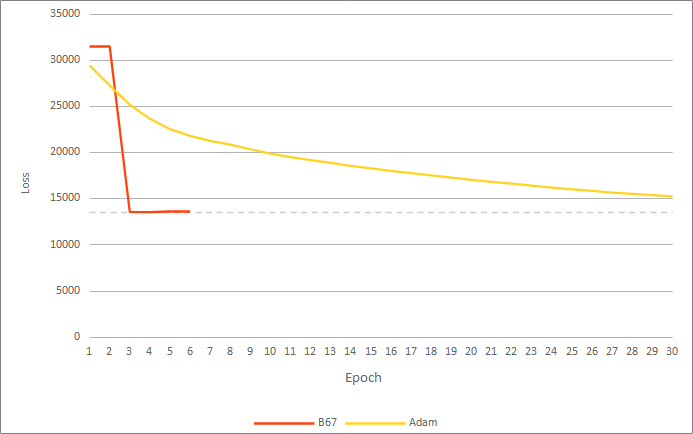
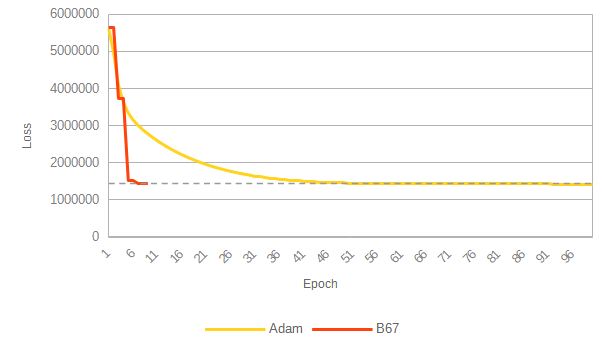
To demonstrate the performance of the B67 algorithm vs. Adam, a bidirectional LSTM neural network was trained on a random-number data set using both algorithms (see Network and Data Set).
B67's loss value after nine epochs was matched by that of the Adam algorithm after 90 epochs (see below). B67 ran for 23 minutes vs. 100 seconds for Adam due to the performance limitation incurred by TensorFlow's constraints on our basic demo implementation (see Performance Penalty). In a production environment, this performance penalty does not exist and the time per epoch would be comparable to Adam.
Result Summary
Results are shown below. A plot of loss vs. time is omitted as it is not representative of performance (see Performance Penalty).
Raw Data
Summary logs and screen output are available.
Demonstration Limitations
Performance Penalty
For this demonstration, B67 is implemented as a custom TensorFlow 'op.' The demonstration runs significantly more slowly than it would in a production environment due to:
- Recalculation of values that TensorFlow has already performed, since the framework does not supply B67's required inputs by default. This recalculation restricts B67 to performing a step once every two epochs.
- CPU implementation, which is many times slower than running calculations on GPU. In a production environment, a B67 epoch would take roughly the same amount of time as an Adam epoch or, with recalculations in (1) performed, roughly the time for two Adam epochs.
Test Setup
Network and Data Set
The network used is the one described in this Keras example without the sigmoid activation on the output node. Since the Keras example converges quickly, we use a random-number data set to better demonstrate relative performance:
- 25,000 samples are used with 200 elements per sample
- Inputs are random integers from 0 to 20,000
- Labels are random integers from 0 to 100
Randomness Minimized for Performance Comparison
The random seeds for Python, Python's numpy library, and TensorFlow are set to fixed values. In addition, shuffling of data sets is disabled.
Note that there still exist unavoidable variations in floating-point values due to non-deterministic ordering of parallel operations and aggregation of GPU calculations.
Loss function, batch size
- The loss function used is: .
- The batch size is 3500 samples (largest possible with available memory).
Adam
Adam was run with default parameters.
Software
- Ubuntu 22.04
- Python 3.10.6
- TensorFlow 2.10.0
Hardware
- CPU: Intel Core i7 8-Core 16-Thread, 2.9GHz Base 4.8 GHz Turbo
- GPU: NVIDIA GeForce RTX 3080 10GB
- RAM: 16GB (2x8GB) DDR4 3600MHz
- Hard drive: 1TB 3000MB/s SSD